Last night's Channel Four 'Dispatches' program seemed to me to be plowing a field that has become increasingly riven of late. As conspicuously studenty journalist Laurie Penny put University Vice Chancellors in her sights, the nation braced itself for more self righteous anger inducing revelations about these senior academic figures with their noses in the publicly funded trough.
The age of austerity, as well as being the go-to buzz phrase for a seeping diminution of general happiness and wellbeing has, it seems, got people wondering where all the money presumably floating around in the infrastructure of the world's sixth largest economy has been magicked off to.
On the evidence of programs like 'Dispatches', it would seem that said money has a way of collecting itself in the pay packets of those charged with allocating it. Channel Four's accusations had a ring of familiarity that can probably be traced to the public interest value in buying into a policy of' 'Look how much this bastard earns. Let's hate him'.
Bankers, Politicians, Public Sector Managers, Big Oil and even crumbly old academics have been 'caught' with their noses in the over-used metaphor, guilty of the sin of earning lots more money than the average Channel Four viewer. For a long time, this sense of indignation was not something we did not share with our American cousins who followed the whispered promise of the American Dream to selfishly recognise that one day, if they worked hard enough, it might be they themselves ignoring the complaints of the working poor as they luxuriated in their Limousine hot tubs. Funnily enough, ten percent unemployment has a way of changing minds.
One has to wonder why, at each 'revelation' people can even summon the energy to be surprised when those at the top of a given system take best advantage of it. Human nature it seems, errs wherever possible on the side of giant pay packets when a man earning £300,000 + is lauded for his nobility and restraint in not asking for a pay rise.
So how can this clustering of money help us in our current straights. In the argument around debt and cutting to manage it, it almost seems forgotten that just as in a household held hostage by their credit card, the only way to get back in the black for the long term is to make money, not to stop eating or buying shampoo.
So, I want to know if it would be possible to set up (and I cringe at employing this term) a 'Big Society Works Program.'
This would be a company,part run by the government which would own a proportion of the shares with the rest sold to investors, perhaps tying in some kind of exchange mechanism via the publicly owned banks and with an integrated charitable trust. The company could have an M.O similar to an industrial version of 'Challenge Annika' and could embark on a program of public works, including rebuilding Britain's road and rail services, urban redevelopment, renewable energies and entrepreneurship, integrated with a massive program of internship-based schemes. Companies and high net worth individuals could be offered investment incentives to take part in the scheme.
It would also be a chance to innovate and create something that could have a lasting value, with private attention to profitability and the public focus on service overseen by the government. This could create jobs and if successful could be a modern blueprint for public-private partnerships that Cameron and friends can point to when they talk about privatising the NHS or other sacred cows. The media too could be offered unprecedented access for as many 'fly on the wall' documentaries as they could make. This would be a project of many stories, and one that would allow the coalition when asked for the umpteenth time to say 'Actually, this is what we meant by the Big Society.'
This is much of the problem with the BS (a fitting acronym if ever there was one) as it currently stands. Anything good it does is virtually invisible, chipping away at a few local issues. For the idea to work, the challenges must also be big. Dare I say it, Nationalism, over localism. PR 101. Make it big, make it visible, make it obvious, have Alan Sugar do a TV show to find the board members.
This would obviously require bravery. It would be a brass balled sticking of the head above the parapet. The media would be like bloodhounds to every perceived crack or flaw, begging it to fail. Perhaps part of the deal could be that reportage and information gathering on the project would have to be done by paid BBC interns from outside of London.
The initiative could be founded upon the following principles:
1. A decent wage for decent work. No indecent salaries or executive bonuses
2. Open opportunities for all qualified people. Many of the works projects would be regional
3. Open media involvement to generate buzz and invite sponsorship
4. An innovation centre where cutting edge ideas could be exchanged and developed
5. An attainable, visible, viable program of public works, even something as simple as filling in pot holes
6. An integrated internship program and the opportunity for small business involvement and development
7. Executive management from some of the best business minds in the country
Given public services are being handed to private companies on the sly in any case, why not make it a workable public initiative that people can get behind and see in action?
Tuesday, 5 April 2011

Wednesday, 30 March 2011
'Apathetic Bloody Planet' - A voyeur's account of Saturday's London Protest
Saturday 26th March. Protest day.
My Saturday was unfolding much like any other in my sleepy Catford flat. I was vaguely aware of breakfast, vaguely aware of Football Focus, half-heartedly attempting some work when the phone rang. It was my girlfriend. Not unusual. She calls often. But that day she was suffering from guilt. Her work colleagues in the NHS were on the march and she felt like she should be making some kind of gesture.
"Ok. We can go and meet up with them." I said.
"No need to go that far." She replied. "But I think I would like to go."
"Ok," I Said. "Bring some felt tip pens and we'll make a banner."
"We don't need a banner you weirdo." She said.
"Of course we do." I said, getting into the spirit of things. "Come over as quick as you can or we'll miss it."
Half an hour of phone-based indecision relating to train times and strategy followed until at last, she gave our tentative plan her seal of approval.
 I carefully selected my wardrobe, opting for my most politically dissident combo of jeans and jumper. I also began to make our banner out of an old curtain pole and a cardboard box which once contained my girlfriend's Christmas present of Carvella shoes. (Unsure what the Socialist Worker's Weekly would have made of that.)
By the time my girlfriend arrived with the pens, I was watching the prattling, tedious News 24 coverage as the march, swollen with people, was making its way towards the centre of London. She had opted for reasons best known to her, to dress like Kate Middleton's black cousin.
"Well we are going into town." She said, indicating in her own way that this expression of our citizen's dissatisfaction might well involve some High Street shopping, whether Oxford Street was in flames or not.
"Fair enough." I said, and showed her the sterling construction work I'd done on our banner.
"Are you really going to carry that thing around?" She said.
"That's the idea." I said. "Now what do you think should be our slogan?"
A long discussion ensued. "Osborne you posh twat!" was vetoed on the grounds of my girlfriend's assertion that twat is a swear word. (She went to Catholic school. I'm from Scotland where 'dickhead' is a term of endearment) I wanted Cameron's famous "I met a Black man once" or "Tories are a bunch of Cuts". We settled on "We are NOT in this together George!!" which was informative if a little camp sounding to my ear. A further hour was enjoyed colouring in the banner. My girlfriend is quite artistic when the mood takes her and we delighted in colouring GEORGE in blue, putting sad and angry smiley faces in the O's, tracing round a pair of scissors (also blue, but a different shade) to symbolise the cuts along with artistically distressed lettering of THE NHS and THE ARTS. We debated whether the exclamation marks should be red or black, but after a brief squabble, settled on black for consistency.
By the time we'd finished the banner, Ed Milliband had taken to his feet in Hyde park, seemingly with the expressed purpose of making a complete fool of himself. The odd-looking school prefect of a man who has never had a job outside politics tried and failed to play the great orator.
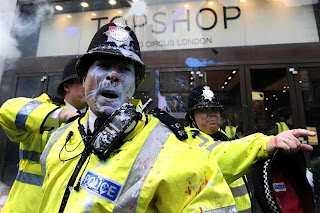 My heart wanted to go out to him, but it didn't. His righteous indignation was off the shelf, his attempt to play 'man of the people' was laughable and his summoning of Dr King was nothing short of embarrassing. At that same moment, Anarchists were attacking shops on Oxford Street and Milliband's speech was played on News 24 in split screen with a vehement assault on Topshop which upset my girlfriend no end. (She would later purchase three items from their online store in a show of solidarity)
Banner complete, we quickly had some tea and Battenberg cake for energy. (The breakfast of bourgeois champions) I filled my rucksack with water and energy bars in case we were kettled and we made our way to Catford station.
My girlfriend, new to protest, was at first, embarrassed to be seen with our work of art. To give her her due, the other denizens of Catford, South London did not seem to know there was a protest on and regarded us with the pitying looks that masked assumptions that we were 'Care in the Community'. My girlfriend actually works in mental health and gets quite a kick out of pretending to be my carer in public.
We chatted animatedly on the train. Our politics are broadly similar. We hate the Tories, mostly due to genetics. (She's black, I'm Scottish) We hate the Lib Dems for being Tories. (I was stupid enough to vote for them. She knew better and enjoys reminding me of the fact.) We broadly dislike Labour and think that Milliband is hopeless. (I hold a grudge over the Hutton Report. She still hasn't forgiven Ken Livingstone for, well, anything...)
As we arrived in Victoria, it was evident we'd perhaps devoted too much time to our preparations. As we wound or way towards Hyde Park on foot, it was clear that we were against the current and that at after 4pm, many protesters were on their way to the pub.
I called a friend of mine who was on the Equity (The Actor's Union) protest. She said that most of the actors had given up, (shock) but that the march had stalled in Piccadilly Circus where "things were getting ugly." With no other plan, we headed over to meet my friend in a Soho Starbucks. I held the banner aloft as we cut through St James' park, passing a young family entirely kitted out in Barbour jackets, blissfully unaware, feeding the ducks. In my forgotten socialist heart, something stirred.
As we made our way up, crossing the Mall into the centre, we could hear the roaring of a large crowd. We'd come out at the back of Fortnum and Mason. My girlfriend asked if we could go in and browse, seemingly unaware of the wall of riot police surrounding the building on three sides. We skipped round onto Piccadilly and found the March and the handful of anarchists who had climbed onto the fronting of F and M, the symbol of London poshness.
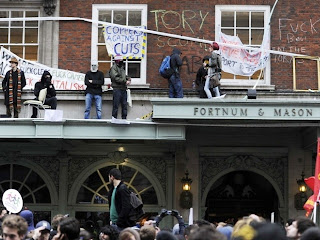 So these were the anarchists. Even in my longing to strike a blow for the common man against the system, I couldn't shake the feeling that these people were complete idiots. They were such a cliché. Skinny young men with questionable hair and combat trousers, women with piercings and tattoos they will regret in their 30s, jumping up and down in a rant so choreographed that it came across like an unhygienic, talentless Glee Club number. There were only a handful of them, and whilst they had got the crowd going and smoke bombs were being thrown, the majority of the marchers caught in the bottleneck looked on with bemusement and frustration. Even so, it was loud and unsettling. My girlfriend insisted we found a group of school children to march next to in case things kicked off.
After sampling the atmosphere, we cut away from the march and went to join my actor friend. Clearly, the anarchists had been busy. We passed many smashed windows of banks and shops. I was surprised and confused to see that, for reasons best known to them, they had completely smashed in the window of Anne Summers but left the Starbucks opposite untouched. Why Anne Summers? I thought anarchy was supposed to be fun. The pedant in me couldn't help noticing that they had misspelled 'Tory' in their graffiti.
So far, our protest had consisted of a pleasant walk through the park, a brief rubberneck at some idiots on a roof and a very nice hot chocolate in the spiritual capital of corporate oppression. I couldn't help noticing that in spite of the apocalyptic images on television, the city, non withstanding one or two broken windows was not in the grip of revolution.
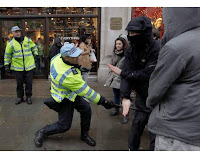 After our hot chocolate, we ambled through towards Covent Garden. At my girlfriend's request, I disassembled our banner so we could go inside vintage clothing shops without alarming the security guards. I pretended the metal curtain pole was a walking stick, a pretense we used to make motorists stop and let us cross the road. The fires of revolution had left us and after dinner in Marylebone, we made our way back to Charing Cross for the train home just as darkness fell, only to discover the closest thing we'd seen to a riot in Trafalgar Square.
It was at this point that my girlfriend, previously keen to avoid trouble, decided she wanted to see things up close. Just as protesters began lobbing flaming debris at a line of police, we crossed into the square. The boys and girls in day glow were trying to protect the much maligned Olympic clock from people who seemed more militant than me about their belief in how pointless it is.
We had to move quickly as vans filled with riot police did their best to park on top of us and loitered on the edge of the square as more and more police began to arrive. It would be accurate to say that a lot of the 'hard line' people in the square were drunk and that the small fires they'd started looked much more dramatic on television. It would also be fair to say that a line of riot police coming towards you with shields and batons can make you glad you brought your curtain pole.
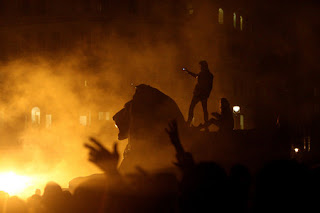 "Kettle!" The shouts went up from some of the black clad lookouts at the edge of the square. At that moment a mass of protesters broke out of the square before the police could encircle them. We were caught up in the rush as they escaped down the Strand and ducked into the station where we watched things unfold until our train back to mundane, unrevolutionary Catford arrived.
As we sat in the flat, drinking tea and buzzing from the adventure, listening to the entirely unrelated and totally normal wail of passing sirens outside, watching the BBCs Trafalgar Square images that made it look like the opening scene of Gladiator, several things occurred to me.
1. British people are rubbish at protesting. The people who protest are not representative of the majority of people who are frustrated with the obvious shortcomings in how the country is run. It was markedly obvious that aside from those protesting the War in Libya, too many of the faces were white, left wing members of decaying unions or eccentric pressure groups. Though the march had been broadly larger than expected, the popular uprisings of the Middle East could teach us much about how to hold an effective demonstration.
2. As my girlfriend pointed out. Stupid and pointless as they are, the only people who actually 'did anything' were the anarchists. They alone seem to have the understanding of what it takes to make yourself heard, non-withstanding the weak, plaintive bleating about the 'vast majority of peaceful demonstrators' who marched peacefully and were completely ignored. They were just as politically impotent as me and my girlfriend and the most revolutionary thing we did that day was send back a Wagamama's curry because it was cold and still felt bad about not tipping. In France they turn over cars and set fire to them, whereas here, limp little bonfires made out of placards are what passes for 'anarchy'.
3. The media are idiots. Harsh when as a journalist, I'm basically insulting myself, but the coverage of the event was not realistic. The crushing predictability of the whole scenario was not disseminated by the media who went from one little flashpoint to the next as if this were the fall of the Berlin Wall.
4. The police are full of disdain. The police do nothing to help themselves, predictably insisting that the numbers involved are half what they are in the face of the wild exaggerations of the demonstrators. They regard the whole thing as a hassle and a waste of time and many do not believe in the politics they are defending in principle when they take up their batons. They completely failed to protect the banks and businesses that had their windows smashed by enemies of the state who are far from the brightest or deadliest in the world. They may be a 'small number of criminals' but when a handful of tanked idiots can smash up the centre with little more than a rock, a stick and and anorack, the police have to look again at their tactics. (As someone who used to work for the Police, I'm not usually quick to criticise)
5. Most importantly, the government is out of touch... and so, regrettably are the opposition, which is perhaps why we might have to get used to making ourselves heard in more direct ways. George Osborne appeared on television in the days before the protest. He actually had the nerve to say that 'He knew how difficult it is for people just now.' No George, you don't. You are part of the most elitist government in two generations and like David, Nick and depressingly, Ed, you have never held a real job within the society you purport to be enlarging. You don't take the Tube, you don't live in Catford, Brixton or Peckham. You are not reliant on any public initiative to give you better access to work or support. You and your friends are not and have never been reliant on anything that you are scrapping.
People actually do see through you all. We also see through the Big Society as a way of passing moral responsibility onto us, as if we should somehow feel guilty about not volunteering to run essential services in the country at ground level. Forgive me George, but that's what you're paid to do...
In one way at least, it seems the march had some effect. In spite of using the day as basically a date with unusual post dinner entertainment, I do feel more political. I think the greatest difficulty of modern politics is in its inability to penetrate real life, (a quandary not aided by the space aliens leading the various parties) but in talking even just to someone I know well, I was struck by what the cuts could mean. My girlfriend works in mental health. She is on a placement in a trust that is facing massive cuts. Unfortunately, and to be non PC, the crazy people are rather selfishly, not aware there's a recession on and will require just as much care and attention even if staff are cut. Blanket cuts will mean that there are less burly nurses to jump on potentially dangerous service users which puts both the service user and the mental healthworker, (mine included), at greater risk. No doubt there are many people, probably more than the half million or so who may or may not have marched on Saturday who could voice similar concerns.
So yes, there is a budget deficit, but we have a right to expect the people we misguidedly elected to come up with a better solution than blanket cuts to services that are more intricate and fragile than our well heeled politicians seem to understand. Because if and when the people we care about are put at risk by cuts, in whatever way, it will not be the anarchists or the unions that David and George have to worry about.
They'll have to worry about the people, because if we take to the streets for real, it will not be to vandalise Topshop.
Thanks to Reuters for images
http://www.nickbain.co.uk/
My Saturday was unfolding much like any other in my sleepy Catford flat. I was vaguely aware of breakfast, vaguely aware of Football Focus, half-heartedly attempting some work when the phone rang. It was my girlfriend. Not unusual. She calls often. But that day she was suffering from guilt. Her work colleagues in the NHS were on the march and she felt like she should be making some kind of gesture.
"Ok. We can go and meet up with them." I said.
"No need to go that far." She replied. "But I think I would like to go."
"Ok," I Said. "Bring some felt tip pens and we'll make a banner."
"We don't need a banner you weirdo." She said.
"Of course we do." I said, getting into the spirit of things. "Come over as quick as you can or we'll miss it."
Half an hour of phone-based indecision relating to train times and strategy followed until at last, she gave our tentative plan her seal of approval.
 I carefully selected my wardrobe, opting for my most politically dissident combo of jeans and jumper. I also began to make our banner out of an old curtain pole and a cardboard box which once contained my girlfriend's Christmas present of Carvella shoes. (Unsure what the Socialist Worker's Weekly would have made of that.)
By the time my girlfriend arrived with the pens, I was watching the prattling, tedious News 24 coverage as the march, swollen with people, was making its way towards the centre of London. She had opted for reasons best known to her, to dress like Kate Middleton's black cousin.
"Well we are going into town." She said, indicating in her own way that this expression of our citizen's dissatisfaction might well involve some High Street shopping, whether Oxford Street was in flames or not.
"Fair enough." I said, and showed her the sterling construction work I'd done on our banner.
"Are you really going to carry that thing around?" She said.
"That's the idea." I said. "Now what do you think should be our slogan?"
A long discussion ensued. "Osborne you posh twat!" was vetoed on the grounds of my girlfriend's assertion that twat is a swear word. (She went to Catholic school. I'm from Scotland where 'dickhead' is a term of endearment) I wanted Cameron's famous "I met a Black man once" or "Tories are a bunch of Cuts". We settled on "We are NOT in this together George!!" which was informative if a little camp sounding to my ear. A further hour was enjoyed colouring in the banner. My girlfriend is quite artistic when the mood takes her and we delighted in colouring GEORGE in blue, putting sad and angry smiley faces in the O's, tracing round a pair of scissors (also blue, but a different shade) to symbolise the cuts along with artistically distressed lettering of THE NHS and THE ARTS. We debated whether the exclamation marks should be red or black, but after a brief squabble, settled on black for consistency.
By the time we'd finished the banner, Ed Milliband had taken to his feet in Hyde park, seemingly with the expressed purpose of making a complete fool of himself. The odd-looking school prefect of a man who has never had a job outside politics tried and failed to play the great orator.
 My heart wanted to go out to him, but it didn't. His righteous indignation was off the shelf, his attempt to play 'man of the people' was laughable and his summoning of Dr King was nothing short of embarrassing. At that same moment, Anarchists were attacking shops on Oxford Street and Milliband's speech was played on News 24 in split screen with a vehement assault on Topshop which upset my girlfriend no end. (She would later purchase three items from their online store in a show of solidarity)
Banner complete, we quickly had some tea and Battenberg cake for energy. (The breakfast of bourgeois champions) I filled my rucksack with water and energy bars in case we were kettled and we made our way to Catford station.
My girlfriend, new to protest, was at first, embarrassed to be seen with our work of art. To give her her due, the other denizens of Catford, South London did not seem to know there was a protest on and regarded us with the pitying looks that masked assumptions that we were 'Care in the Community'. My girlfriend actually works in mental health and gets quite a kick out of pretending to be my carer in public.
We chatted animatedly on the train. Our politics are broadly similar. We hate the Tories, mostly due to genetics. (She's black, I'm Scottish) We hate the Lib Dems for being Tories. (I was stupid enough to vote for them. She knew better and enjoys reminding me of the fact.) We broadly dislike Labour and think that Milliband is hopeless. (I hold a grudge over the Hutton Report. She still hasn't forgiven Ken Livingstone for, well, anything...)
As we arrived in Victoria, it was evident we'd perhaps devoted too much time to our preparations. As we wound or way towards Hyde Park on foot, it was clear that we were against the current and that at after 4pm, many protesters were on their way to the pub.
I called a friend of mine who was on the Equity (The Actor's Union) protest. She said that most of the actors had given up, (shock) but that the march had stalled in Piccadilly Circus where "things were getting ugly." With no other plan, we headed over to meet my friend in a Soho Starbucks. I held the banner aloft as we cut through St James' park, passing a young family entirely kitted out in Barbour jackets, blissfully unaware, feeding the ducks. In my forgotten socialist heart, something stirred.
As we made our way up, crossing the Mall into the centre, we could hear the roaring of a large crowd. We'd come out at the back of Fortnum and Mason. My girlfriend asked if we could go in and browse, seemingly unaware of the wall of riot police surrounding the building on three sides. We skipped round onto Piccadilly and found the March and the handful of anarchists who had climbed onto the fronting of F and M, the symbol of London poshness.
 So these were the anarchists. Even in my longing to strike a blow for the common man against the system, I couldn't shake the feeling that these people were complete idiots. They were such a cliché. Skinny young men with questionable hair and combat trousers, women with piercings and tattoos they will regret in their 30s, jumping up and down in a rant so choreographed that it came across like an unhygienic, talentless Glee Club number. There were only a handful of them, and whilst they had got the crowd going and smoke bombs were being thrown, the majority of the marchers caught in the bottleneck looked on with bemusement and frustration. Even so, it was loud and unsettling. My girlfriend insisted we found a group of school children to march next to in case things kicked off.
After sampling the atmosphere, we cut away from the march and went to join my actor friend. Clearly, the anarchists had been busy. We passed many smashed windows of banks and shops. I was surprised and confused to see that, for reasons best known to them, they had completely smashed in the window of Anne Summers but left the Starbucks opposite untouched. Why Anne Summers? I thought anarchy was supposed to be fun. The pedant in me couldn't help noticing that they had misspelled 'Tory' in their graffiti.
So far, our protest had consisted of a pleasant walk through the park, a brief rubberneck at some idiots on a roof and a very nice hot chocolate in the spiritual capital of corporate oppression. I couldn't help noticing that in spite of the apocalyptic images on television, the city, non withstanding one or two broken windows was not in the grip of revolution.
 After our hot chocolate, we ambled through towards Covent Garden. At my girlfriend's request, I disassembled our banner so we could go inside vintage clothing shops without alarming the security guards. I pretended the metal curtain pole was a walking stick, a pretense we used to make motorists stop and let us cross the road. The fires of revolution had left us and after dinner in Marylebone, we made our way back to Charing Cross for the train home just as darkness fell, only to discover the closest thing we'd seen to a riot in Trafalgar Square.
It was at this point that my girlfriend, previously keen to avoid trouble, decided she wanted to see things up close. Just as protesters began lobbing flaming debris at a line of police, we crossed into the square. The boys and girls in day glow were trying to protect the much maligned Olympic clock from people who seemed more militant than me about their belief in how pointless it is.
We had to move quickly as vans filled with riot police did their best to park on top of us and loitered on the edge of the square as more and more police began to arrive. It would be accurate to say that a lot of the 'hard line' people in the square were drunk and that the small fires they'd started looked much more dramatic on television. It would also be fair to say that a line of riot police coming towards you with shields and batons can make you glad you brought your curtain pole.
 "Kettle!" The shouts went up from some of the black clad lookouts at the edge of the square. At that moment a mass of protesters broke out of the square before the police could encircle them. We were caught up in the rush as they escaped down the Strand and ducked into the station where we watched things unfold until our train back to mundane, unrevolutionary Catford arrived.
As we sat in the flat, drinking tea and buzzing from the adventure, listening to the entirely unrelated and totally normal wail of passing sirens outside, watching the BBCs Trafalgar Square images that made it look like the opening scene of Gladiator, several things occurred to me.
1. British people are rubbish at protesting. The people who protest are not representative of the majority of people who are frustrated with the obvious shortcomings in how the country is run. It was markedly obvious that aside from those protesting the War in Libya, too many of the faces were white, left wing members of decaying unions or eccentric pressure groups. Though the march had been broadly larger than expected, the popular uprisings of the Middle East could teach us much about how to hold an effective demonstration.
2. As my girlfriend pointed out. Stupid and pointless as they are, the only people who actually 'did anything' were the anarchists. They alone seem to have the understanding of what it takes to make yourself heard, non-withstanding the weak, plaintive bleating about the 'vast majority of peaceful demonstrators' who marched peacefully and were completely ignored. They were just as politically impotent as me and my girlfriend and the most revolutionary thing we did that day was send back a Wagamama's curry because it was cold and still felt bad about not tipping. In France they turn over cars and set fire to them, whereas here, limp little bonfires made out of placards are what passes for 'anarchy'.
3. The media are idiots. Harsh when as a journalist, I'm basically insulting myself, but the coverage of the event was not realistic. The crushing predictability of the whole scenario was not disseminated by the media who went from one little flashpoint to the next as if this were the fall of the Berlin Wall.
4. The police are full of disdain. The police do nothing to help themselves, predictably insisting that the numbers involved are half what they are in the face of the wild exaggerations of the demonstrators. They regard the whole thing as a hassle and a waste of time and many do not believe in the politics they are defending in principle when they take up their batons. They completely failed to protect the banks and businesses that had their windows smashed by enemies of the state who are far from the brightest or deadliest in the world. They may be a 'small number of criminals' but when a handful of tanked idiots can smash up the centre with little more than a rock, a stick and and anorack, the police have to look again at their tactics. (As someone who used to work for the Police, I'm not usually quick to criticise)
5. Most importantly, the government is out of touch... and so, regrettably are the opposition, which is perhaps why we might have to get used to making ourselves heard in more direct ways. George Osborne appeared on television in the days before the protest. He actually had the nerve to say that 'He knew how difficult it is for people just now.' No George, you don't. You are part of the most elitist government in two generations and like David, Nick and depressingly, Ed, you have never held a real job within the society you purport to be enlarging. You don't take the Tube, you don't live in Catford, Brixton or Peckham. You are not reliant on any public initiative to give you better access to work or support. You and your friends are not and have never been reliant on anything that you are scrapping.
People actually do see through you all. We also see through the Big Society as a way of passing moral responsibility onto us, as if we should somehow feel guilty about not volunteering to run essential services in the country at ground level. Forgive me George, but that's what you're paid to do...
In one way at least, it seems the march had some effect. In spite of using the day as basically a date with unusual post dinner entertainment, I do feel more political. I think the greatest difficulty of modern politics is in its inability to penetrate real life, (a quandary not aided by the space aliens leading the various parties) but in talking even just to someone I know well, I was struck by what the cuts could mean. My girlfriend works in mental health. She is on a placement in a trust that is facing massive cuts. Unfortunately, and to be non PC, the crazy people are rather selfishly, not aware there's a recession on and will require just as much care and attention even if staff are cut. Blanket cuts will mean that there are less burly nurses to jump on potentially dangerous service users which puts both the service user and the mental healthworker, (mine included), at greater risk. No doubt there are many people, probably more than the half million or so who may or may not have marched on Saturday who could voice similar concerns.
So yes, there is a budget deficit, but we have a right to expect the people we misguidedly elected to come up with a better solution than blanket cuts to services that are more intricate and fragile than our well heeled politicians seem to understand. Because if and when the people we care about are put at risk by cuts, in whatever way, it will not be the anarchists or the unions that David and George have to worry about.
They'll have to worry about the people, because if we take to the streets for real, it will not be to vandalise Topshop.
Thanks to Reuters for images
http://www.nickbain.co.uk/
Monday, 28 March 2011
Jamie's Dream School Review
 Good intentions drip from this programme like one of Jamie’s rich sauces and I have found myself so compelled by this telling insight into teachers and the taught that I am yet to miss an episode.
I wanted to wait to see how the experiment unfolded before setting down any thoughts, but find myself struggling to make sense of it, and not least the worrying allusions to the future.
I went to six different schools, so have had a broad taste of the education spectrum through the 1990s. The last school I went to was then ranked in the bottom five in the country. I now teach in a prison so know what it is to have challenging students with sob stories and tough backgrounds. What concerns me most about the Dream School
Alarm bells should begin to sound at this premise, but Dream School
 As American Entrepreneur Alvin Hall said after his own turbulent class, these kids are ‘not bright’, but they are smart enough to see that they hold all the power. They seem to be allowed to come and go as they please and pretty much do what they want. The uniform policy seemed to have quietly disintegrated by day two without any hint of a challenge.
Such discipline as is imposed is either misguided like the efforts of David Starkey, toothless like those of the school’s long suffering headmaster and all ultimately undermined by the overly pally, hyper sentimental mumblings of Oliver himself.
David Starky rightly came in for criticism after his snide approach to his first lesson but his underlying instinct to challenge the pandering, softball, kid-gloved approach to dealing with hard, worldly, system-wise young men and women was not wrong.
If initiatives like Dream School
 The battles the teachers fight for basic respectful behaviour from their students would be aided by an attempt to address this problem, alongside an admission that in the real world education is not always going to be exciting all of the time.
The real world will not give the constant one-to-one attention and praise that some of them crave or reward them for completing basic tasks without giving up. The real world will not care if, as volatile student Harlem is fond of saying ‘that’s just the way I am.’ The real world is unfair and in large part uncompromising. It will sack them and mean it.
So if not education, perhaps the value of Dream School
So Dream School
So in this heralded age of austerity, I suspect that young people don’t need a dream from Jamie, they need a dose of reality.
Many thanks to C4 for images.
http://www.nickbain.co.uk/
Many thanks to C4 for images.
http://www.nickbain.co.uk/
Monday, 21 February 2011
Axis of Not So Evil?
After the decade just past, many people in Western countries could perhaps be understood for harbouring a subliminal unease at Islamic nations, organisations and even people. This, if we are honest has not been the occupation merely of the BNP or English Defence League. Islam, in its cartoon-villain portrayal has been 'the bad guy' for ten years or more with little real differentiation between its various strands.
But now we have the opportunity to see much of the Islamic world at its ideological best. What strikes me most about this is the overwhelming bravery, a cousin perhaps of the same conviction however misguided that has made fundamentalist Islam such a dangerous enemy. Any way you regard it, these are people who are willing to die for what they believe in. Now it seems that the peoples of Tunisia, Egypt, Bahrain, Libya and even Iran are turning this most powerful of weapons upon their long entrenched, long unquestioned masters.
It seems that we can respond to this sweeping wave of democratic expression in a number of ways. There is noticeable unease at the 'Real Politic' of the situation. Dictators however awful have provided a stability of sorts and also perpetuated a laziness in our commercially orientated diplomacy. Far easier to understand the whims of one overlord, however eccentric than embrace the messy, complicated, mannered chaos of a democratic government, particularly in its messy foetal stages.
Britain and the US, outward cheerleaders for democracy have been chastened in this expression by the long heralded elections in Gaza which brought Hamas to power. It seems there is no position of response for those who express their championed democratic rights by voting for people we don't like. So Obama and friends sit uncomfortably on the fence, waiting and hoping for the settling of the dust in such a way that their own interests in the region are not compromised. This is not a heartless response. Pragmatism keeps the lights on and means that there is petrol at the pumps.
However, as the Libyan uprising encounters the most cold-blooded regime response yet, the time may be coming when the outside world will have to choose whether to act in support, daring that such an action would be received well by the people and not in the oft painted way of their dictators who claim a sinister Western influence and seek to unite their people behind a xenophobic patriotism. A risk yes, but less so at a time when people are no longer slavishly buying the pantomime posturing of their jilted masters.
As people who generally do not hold our leaders to such account, the answer for now may be to embrace this action ourselves through the same social media as have given oxygen to the popular movements and helped turn whispered discontent into real revolutions. In any case, these new democracies are going to need support and reintegration into the international political and economic communities and we as a people, if not as a nation do not want to be seen as having perpetuated the regimes that are now close to collapse.
In short, just like in the changing countries on our news channels, what we do now as a people and as a country is vitally important. Can we find some of the same great motivation which for us requires no more bravery than to turn on our computers and email our friends and MPs?
Or will our brothers and sisters in the East who have been democratic for all of a week once again put us to shame?
http://www.nickbain.co.uk/
But now we have the opportunity to see much of the Islamic world at its ideological best. What strikes me most about this is the overwhelming bravery, a cousin perhaps of the same conviction however misguided that has made fundamentalist Islam such a dangerous enemy. Any way you regard it, these are people who are willing to die for what they believe in. Now it seems that the peoples of Tunisia, Egypt, Bahrain, Libya and even Iran are turning this most powerful of weapons upon their long entrenched, long unquestioned masters.
It seems that we can respond to this sweeping wave of democratic expression in a number of ways. There is noticeable unease at the 'Real Politic' of the situation. Dictators however awful have provided a stability of sorts and also perpetuated a laziness in our commercially orientated diplomacy. Far easier to understand the whims of one overlord, however eccentric than embrace the messy, complicated, mannered chaos of a democratic government, particularly in its messy foetal stages.
Britain and the US, outward cheerleaders for democracy have been chastened in this expression by the long heralded elections in Gaza which brought Hamas to power. It seems there is no position of response for those who express their championed democratic rights by voting for people we don't like. So Obama and friends sit uncomfortably on the fence, waiting and hoping for the settling of the dust in such a way that their own interests in the region are not compromised. This is not a heartless response. Pragmatism keeps the lights on and means that there is petrol at the pumps.
However, as the Libyan uprising encounters the most cold-blooded regime response yet, the time may be coming when the outside world will have to choose whether to act in support, daring that such an action would be received well by the people and not in the oft painted way of their dictators who claim a sinister Western influence and seek to unite their people behind a xenophobic patriotism. A risk yes, but less so at a time when people are no longer slavishly buying the pantomime posturing of their jilted masters.
As people who generally do not hold our leaders to such account, the answer for now may be to embrace this action ourselves through the same social media as have given oxygen to the popular movements and helped turn whispered discontent into real revolutions. In any case, these new democracies are going to need support and reintegration into the international political and economic communities and we as a people, if not as a nation do not want to be seen as having perpetuated the regimes that are now close to collapse.
In short, just like in the changing countries on our news channels, what we do now as a people and as a country is vitally important. Can we find some of the same great motivation which for us requires no more bravery than to turn on our computers and email our friends and MPs?
Or will our brothers and sisters in the East who have been democratic for all of a week once again put us to shame?
http://www.nickbain.co.uk/
Wednesday, 8 December 2010
Taxing Flights Taxes
 Right. So the planet is warming and it's at least partly our fault. I'm no climate expert but I can sign on for this in theory and principle. Smart people seem to think so and it makes a certain amount of sense to me.
According to various statistics, aviation accounts for anything up to 5% of the world's carbon emissions. In response to this, the government has introduced taxation policies designed to act as 'Economic disincentives' to keep people out of the sky.
Let's examine the phrase 'Economic disincentive' aka, the government's excuse for presenting the aviation industry and by default, us with tax bills on flights that can be anything up to 100% of the cost of the flight.
This is grim but bearable if you're trying to get from London to Dublin. This disincentive might encourage you to get a ferry, but what about further afield?
Here's an example. As a pale and interesting Scotsman, I make a relatively recent and strange addition to London's Caribbean Community. (It still takes a couple of attempts for me to spell Caribbean) However, by extension of my beautiful lady, I find myself part of a family still largely based on the island of St Lucia.
St Lucia is 4,222 miles from London.
 So let's examine our economic disincentives again. The best fare, assuming you can book well in advance currently rebounds around the price comparison websites at £376. Not bad I hear you say. More than a few would pay that to escape our winter and bask in an average daily temperature of 27 degrees.
But here comes the tax, crashing in at a whopping £220 bringing the total cost up to around the £600 mark. This is, it must be emphasised, the best case scenario. (Fly tomorrow and expect to pay double that.)
My question is, how can a disincentive work in this case? It's a long swim to St Lucia. In my experience, the main reasons an average-income family goes home are to see family, attend weddings and in the case of my girlfriend's family, funerals.
My girlfriend's mum has had to bury her sister-in-law and her own mother within three months and has consequently given the tax man the best part of £500. The second time, we went with her and gave him another £500. In each case, she had no choice but to fly, no choice but to travel in peak time.

Ergo, inflated air travel taxation cannot help but punish the people who have no alternative but to travel. It is disproportionately hard on people with family abroad - ethic minorities being an obvious part of this.
It strikes me that this policy has been designed primarily for the government to:
A. Line its own pocket
B. Be seen to be 'doing something' about climate change whilst doing very little about industry and agricultural emissions (which make up a far higher percentage of global emissions) and failing to secure stronger international agreement
C. Continue to transfer responsibility for carbon emissions away from the state and onto the individual to cover the fact that the state does very little to change things
D. Demonise the aviation industry (A fun game we can all enjoy)
E. Try to create some sort of bizarre alternate reality where flying in a plane, rather than being an everyday reality of our globalised, multicultural society is in fact a luxury enjoyed by carefree, voyeuristic, middle-class holiday makers who must be made to see how selfish they're being through the bleeding of their pockets in the hope that they learn the error of their ways.
It is true that some airlines offer 'Bereavement deals', which discount the fare, but these are often only available on business class tickets and in effect cost more than the economy fare. And though stretched by increasing fuel prices and a recession, airlines are at least forced to keep their prices in check by competition.
The government has no such compulsion.
So you have a situation where because of the taxes nominally designed to make fewer people fly, a daughter must either stay away, or go into debt so she can fly home, alone, to bury her mother. In most cases, she'll find a way to fly anyway, rendering the policy barbaric and pointless.
A solution?
 Lower aviation taxes on economy flights and come up with a strategy to fight global warming that doesn't ground people on low incomes. Perhaps counter this with an according rise in tax on business and first class fares. As a proportion of a fare, this effects people less and would only strike those who can either afford it, or are on business in which instance the tax can be claimed back in any case.
And if that cannot be done...
Perhaps the government, in line with the baby steps the airlines are making could introduce a system whereby people can at the very least claim back the aviation tax on bereavement flights for immediate family members.
And please stop guilting us for travelling! Its the 21st century after all...
http://www.nickbain.co.uk/
Sunday, 21 November 2010
Should I Wear Contact Lenses?
Most wearers of glasses will entertain this question at some point. As someone who routinely left my glasses on public transport, contacts began to look distinctly economical, so I decided to switch to them.
Choosing the lens for you
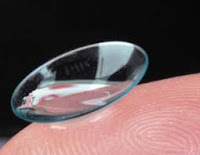 I had not considered contacts before because I have astigmatism, something that was only comparatively recently made treatable with contacts. I loved the idea of being able to abandon my glasses. For those with more general prescriptions there is a massive choice of daily, weekly and monthly disposable options.
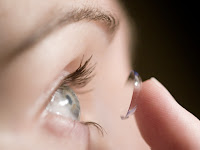 The sensation is strange at first, but it is quite amazing how soon the eye forgets the lens is even there. I opted for soft lenses as they are more comfortable than hard lenses and barely noticed as the optician slid them into my eyes with practiced ease. At first and unsurprisingly, it feels like you have something in your eye, but I found my eyes adjusted remarkably quickly and the quality of vision was excellent.
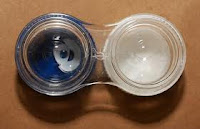 This was compounded by my girlfriend, (A long time contact lens wearer) who, after enjoying my plight for over an hour, removed her daily disposables with a single, deft brushing motion as if merely wiping her brow. I forgave her eventually.
With most kinds of lens, it isn’t advisable to leave them in overnight. Should that happen, usually after a night out, you have to rehydrate them with solution. They are remarkably durable and rehydrate when stored in their container.
Choosing the lens for you
 I had not considered contacts before because I have astigmatism, something that was only comparatively recently made treatable with contacts. I loved the idea of being able to abandon my glasses. For those with more general prescriptions there is a massive choice of daily, weekly and monthly disposable options.
Putting them in
 The sensation is strange at first, but it is quite amazing how soon the eye forgets the lens is even there. I opted for soft lenses as they are more comfortable than hard lenses and barely noticed as the optician slid them into my eyes with practiced ease. At first and unsurprisingly, it feels like you have something in your eye, but I found my eyes adjusted remarkably quickly and the quality of vision was excellent.
Buoyed by this confidence, I opted to keep them in. The optician had shown me how to remove them. How hard could it be..?
Taking them out
Later that night, under the dim, hateful light of our bathroom’s energy-saving bulb, eyes raw from the persistent ineffectual fumbling of my suddenly giant, cumbersome fingers, I realised this was going to take some practice.
Later that night, under the dim, hateful light of our bathroom’s energy-saving bulb, eyes raw from the persistent ineffectual fumbling of my suddenly giant, cumbersome fingers, I realised this was going to take some practice.
 This was compounded by my girlfriend, (A long time contact lens wearer) who, after enjoying my plight for over an hour, removed her daily disposables with a single, deft brushing motion as if merely wiping her brow. I forgave her eventually.
 With most kinds of lens, it isn’t advisable to leave them in overnight. Should that happen, usually after a night out, you have to rehydrate them with solution. They are remarkably durable and rehydrate when stored in their container.
The Benefits
So whilst it must be said that they take some getting used to, particularly in their application and removal, you only feel like a troll attempting brain surgery for a few days. It does get much easier. This frees you up to enjoy the benefits. You do forget you’re wearing them, and the vision is perfect. You either dispose of them daily or clean them with a dunk in solution overnight. No more smeary, steamed up, rain-fogged glasses to leave on buses.
Your eyes might well react to them a little at first. In my first week wearing lenses I was turned away from a club by bouncers because my eyes were a bit red. They were good natured enough when I explained I wasn’t off my face on drugs but just inept at putting in my lenses. One of the bouncers understood. He wore contacts himself and they were a lifesaver because he couldn’t wear glasses on the doors.
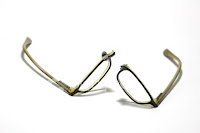
Apparently, people hit bouncers who wear glasses.

Apparently, people hit bouncers who wear glasses.
So Goodbye to Glasses!
Once you have your prescription, the High Street chains are very keen to sign you into monthly contracts but some online retailers guarantee to provide the cheapest non-subscription contact lenses. This really saves you money because I soon found that though I didn’t wear my lenses all the time, vast quantities kept arriving every month. I cancelled my subscription and now just top up when I need to.
So now, I am a fully converted contact lens wearer, and I’ve quite literally, never looked back.
http://www.nickbain.co.uk/
http://www.nickbain.co.uk/
Subscribe to:
Posts (Atom)